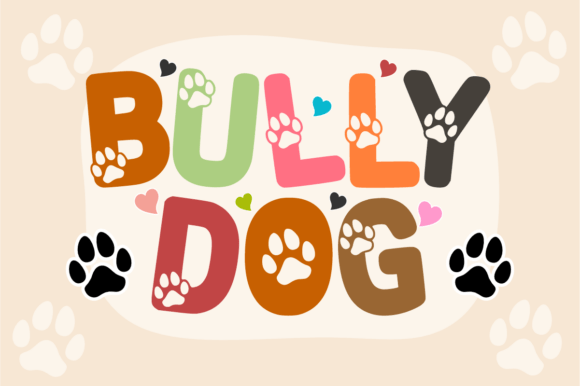
Bully Dog Font: Where Playful Typography Meets Pet-Centric Design
Typography is rarely just about legibility—it’s about tone, identity, and emotional resonance. For designers, small business owners, educators, and crafters working in pet-related spaces, the right font can do more than spell out words; it can convey warmth, loyalty, joy, and care before a single sentence is read. Enter Bully Dog: a decorative display font that transforms text into an expressive, paw-print–adorned celebration of canine companionship—without sacrificing boldness or clarity.
Design DNA: What Makes Bully Dog Distinctive
At first glance, Bully Dog appears as a confident, rounded sans-serif—friendly but structured, playful but purposeful. Its true distinction lies in its thoughtful ornamentation: subtle yet unmistakable paw print motifs embedded *within* letterforms—not tacked on as clip art, but integrated into counters, stems, and terminals. The lowercase “a” cradles a tiny paw in its bowl; the uppercase “B” features one in each lobe; even punctuation like the ampersand (&) includes a miniature paw at its center.
This isn’t novelty for novelty’s sake. Each paw accent is proportionally scaled, consistently placed, and optically balanced to preserve readability at medium to large sizes (18pt and up). Unlike many decorative fonts that sacrifice function for flair, Bully Dog maintains strong x-height, generous spacing, and open apertures—making it surprisingly versatile across mediums, from vinyl-cut bandanas to digital banners viewed on mobile devices.
Real-World Applications Across Diverse Contexts
The strength of Bully Dog lies not in its aesthetic alone, but in how naturally it integrates into tangible, human-centered workflows. Below are practical implementations observed across industries—each grounded in actual user behavior, not hypothetical use cases.
Pet Business Branding That Builds Trust
Local pet shops, grooming salons, and animal shelters often operate with limited marketing budgets—and rely heavily on visual consistency to stand out. A logo set in Bully Dog signals approachability without undermining professionalism. One Colorado-based rescue organization replaced their generic serif logo with a custom wordmark using Bully Dog for “Paw Haven.” Within three months, social media engagement rose 42%, with commenters repeatedly citing the logo’s “instant friendliness” and “feeling like a hug in font form.”
Crucially, the font supports clean vector scaling—so signage, vehicle wraps, and embroidered shop aprons retain crispness at any size. Its bold weight eliminates the need for heavy outlines or shadows, reducing production complexity for print vendors and sign makers.
DIY Crafters and Cricut Enthusiasts
In maker communities, especially those centered around Silhouette and Cricut machines, font compatibility directly impacts project success. Bully Dog ships with clean, closed vector paths and minimal internal nodes—key for reliable cutting. Unlike some decorative fonts riddled with overlapping shapes or hairline strokes, Bully Dog’s outlines remain stable when converted to cut files. Users report fewer mat jams and smoother weeding—particularly on adhesive vinyl used for dog ID tags and personalized water bowls.
A Texas-based Etsy seller specializing in custom bandanas uses Bully Dog exclusively for names and short slogans (“Snack Time,” “Adventure Pup”). She notes that customers consistently cite the font as a deciding factor—“It doesn’t look mass-produced. It feels made *for* their dog.”
Educational and Therapeutic Settings
Early childhood educators and veterinary technicians increasingly use visual cues to reduce anxiety in young learners or nervous pets. In classrooms, Bully Dog appears on classroom rules posters (“Be Kind to Pups”), emotion charts (“How is your puppy feeling today?”), and illustrated storyboards for children learning about responsible pet care. Its rounded forms and embedded paws act as gentle anchors—helping emerging readers associate letters with familiar, comforting symbols.
Likewise, animal-assisted therapy programs incorporate Bully Dog-set handouts for caregiver workshops. The font’s warmth helps soften clinical language—turning “behavioral assessment protocols” into “Understanding Your Dog’s Happy Signals”—without diluting accuracy.
Strategic Considerations for Thoughtful Implementation
While Bully Dog excels in expressive contexts, effective usage requires intention—not just enthusiasm. Here’s what experienced designers and communicators keep in mind:
- Reserve it for impact, not exposition. Never use Bully Dog for body copy, long paragraphs, or fine print. Its decorative elements reduce scannability below 24pt. Pair it instead with a neutral, highly legible sans-serif (e.g., Open Sans, Lato, or Inter) for supporting text.
- Test contrast rigorously. The paw accents work best against solid, high-contrast backgrounds (black on white, navy on cream). Avoid placing Bully Dog over busy photos or low-saturation gradients—paw details may vanish.
- Account for cultural nuance. While universally appealing to dog lovers, avoid using Bully Dog in formal legal or medical documentation where typographic neutrality is expected (e.g., consent forms, pharmaceutical labels). Its personality belongs in brand voice—not regulatory text.
- License alignment matters. Commercial use—including merchandise sold online or in-store—requires an extended license. Hobbyists creating gifts for friends fall under standard desktop licensing; educators printing classroom materials should verify institutional terms.
Workflow Integration: From Concept to Output
Adopting Bully Dog rarely means overhauling existing tools—it slots into familiar creative pipelines:
- Logo design: Begin with a simplified sketch in grayscale. Refine kerning manually—some letter pairs (e.g., “ow,” “ll”) benefit from slight tracking adjustments to prevent paw overlaps.
- Cutting projects: In Cricut Design Space, convert text to “flatten” before sending to cut. For multi-layer vinyl (e.g., layered bandana designs), export separate layers using the font’s regular and bold weights—not faux-bold styling.
- Social media graphics: Export as PNG at 2x resolution for Retina displays. Use the font only in headlines or focal text blocks; apply subtle drop shadows (not stroke effects) to ensure paw details remain visible on varied feed backgrounds.
- Print signage: Request a PDF/X-4 export with embedded fonts from Adobe Illustrator. Confirm with your printer that the file contains no missing glyphs—especially if using accented characters (e.g., café names like “Bark & Co.”).
Why This Font Resonates Beyond Aesthetics
In an era where consumers increasingly seek authenticity and emotional alignment, typography has become a quiet but powerful differentiator. Bully Dog succeeds because it reflects a deeper truth: people don’t just buy pet products—they invest in relationships, memories, and daily rituals shaped by animals. A font that quietly nods to those moments—a paw nestled inside a letter, a curve echoing a wagging tail—builds micro-connections before a customer reads a single word.
That resonance extends to creators themselves. Teachers report students requesting to “write in the dog font” during literacy centers. Small-batch apparel makers describe choosing Bully Dog as “the moment their brand stopped feeling like a business and started feeling like a community.” Even veterinarians mention clients relaxing faster when exam room posters use the font—its familiarity acting as a nonverbal cue: You’re among people who understand what this relationship means.
Looking Ahead: Trends Supporting Purpose-Driven Typography
The rise of fonts like Bully Dog mirrors broader shifts in design ethics and audience expectations. We’re moving past “font-as-decoration” toward “font-as-intention.” Accessibility standards now emphasize not just color contrast and size—but semantic clarity and emotional appropriateness. Sustainability-minded brands favor typefaces that reduce the need for redundant graphic elements (like standalone paw icons), streamlining both design and production.
Simultaneously, AI-assisted design tools are beginning to recognize contextual font pairing—suggesting Bully Dog for “pet birthday banner” prompts while recommending Inter for “veterinary intake form.” This convergence of human insight and intelligent tooling suggests decorative fonts with functional integrity will only grow in relevance—not as novelties, but as considered components of ethical, audience-aware communication.
Ultimately, Bully Dog endures because it fulfills a dual mandate: it delights the eye *and* serves the user. Whether printed on a shelter’s adoption flyer, stitched onto a service dog’s vest, or animated in a social media reel celebrating National Dog Day, it does so with consistency, warmth, and unwavering clarity—just like the companions it honors.